

A Basque consortium, led by Iberdrola, has launched the KATA project, an ambitious R&D initiative that will develop new technologies across the entire value chain of renewable hydrogen carriers, from their generation to final use, with the aim of accelerating the energy transition in maritime transport and the steel industry.
In line with the objectives of the European Green Deal, which places renewable gases at the core of climate neutrality, KATA addresses one of the major challenges of the energy transition: how to efficiently produce, transport and use the energy vectors that will make it possible to replace fossil fuels in the sectors that are most difficult to electrify.
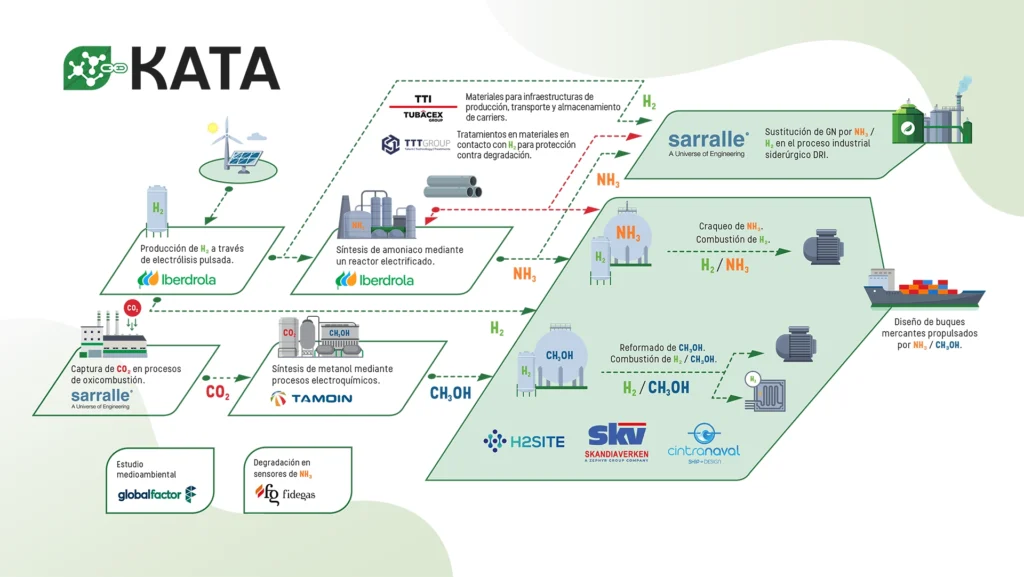
The project investigates innovative technological solutions throughout the entire value chain of hydrogen carriers. These include the development of new green hydrogen production processes through pulsed electrolysis, capable of increasing the efficiency and purity of the gas obtained; dynamic synthesis of green ammonia at low temperature and pressure using induction-electrified reactors; and the production of renewable methanol from captured CO₂ through electrochemical conversion, using selective catalysts and ion-exchange membranes to maximize process performance.
Onboard Technologies for Maritime Transport
In the field of maritime transport, KATA will develop and simulate new propulsion systems for vessels powered by hydrogen, ammonia and methanol, including onboard ammonia cracking and methanol reforming technologies for hydrogen generation on board. In addition, a proprietary tool will be created to define the technical and design requirements of future merchant vessels, aligned with the sector’s decarbonization objectives.
Innovative Solutions for the Steel Industry
For the steel sector, the project will identify the technical requirements needed to replace natural gas with hydrogen and green ammonia by reducing agents in industrial DRI (Direct Reduced Iron) processes. In parallel, new adsorbent materials for CO₂ capture in oxy-fuel combustion processes will be investigated, seeking high capture capacity, stability against humidity and energy-efficient regeneration.
New Materials and Cross-Cutting Tools
KATA will also address challenges related to material compatibility with hydrogen carriers through the development of new coatings and surface treatments, as well as the improvement of ammonia sensors, analyzing their degradation to develop advanced control algorithms and predictive maintenance strategies.
As a cross-cutting axis, the project will develop a proprietary economic and environmental assessment tool, which will make it possible to quantify the impact of the technologies developed and facilitate the issuance of Guarantees of Origin for renewable gases, strengthening the traceability and market value of these solutions.
The consortium, coordinated by Iberdrola, is made up of Cintranaval, Fidegas, Global Factor, H2Site, Sarmel, SKV, Tamoin, TTT and Tubacex, with the participation of the University of the Basque Country (EHU), Tecnalia and Tubacex Innovación as agents of the Basque Science, Technology and Innovation Network (RVCTI).
The KATA project, funded by the Basque Government’s Hazitek program, will run for three years (2025–2027) and positions Euskadi at the European forefront of the development of hydrogen carriers as pillars of the new decarbonized economy.